Project snapshot
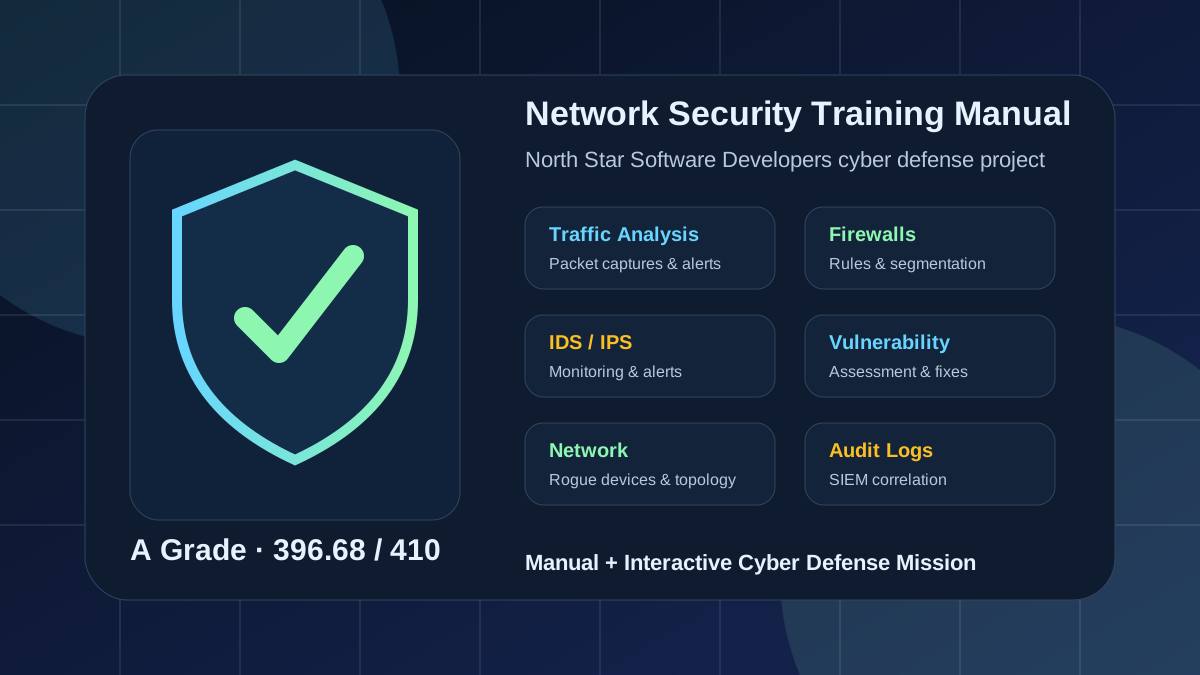
The manual was written for a scenario where North Star Software Developers experienced a server compromise that may have exposed personal information and credit card data. The deliverable translates cybersecurity concepts into employee-ready procedures for capturing traffic, reviewing alerts, configuring controls, assessing vulnerabilities, and documenting security activity.
Score
A — 396.68 / 410
Course artifact
Final network security training manual
Audience
IT employees and security stakeholders
Bonus build
Interactive cyber defense mission website
What I built
I created a 91-page company training manual for North Star Software Developers. The manual covers the full defensive workflow: traffic analysis, packet capturing, firewall rule creation, network segmentation, blocking/allowing/filtering traffic, intrusion detection and prevention, vulnerability assessment, network assessment, auditing, log collection, SIEM correlation, and a summary of approved tools.
I also created an interactive HTML training companion called NSSD Cyber Defense Mission. It turns the manual into a plain-language training experience with sections for the mission scenario, security layers, incident response flow, approved tools, glossary terms, and quiz-style reinforcement.
Why I built it
The purpose was to show how network security documentation should support real business needs after a compromise. The scenario required more than defining tools. It required explaining how packet captures, firewall records, IDS/IPS alerts, vulnerability findings, endpoint logs, and SIEM correlation work together during investigation, mitigation, and response.
How I structured the work
| Manual section | What it covers | Portfolio value |
|---|---|---|
| Executive overview | Purpose, network defense assessment, mitigation assessment, and incident response assessment | Connects technical work to risk, business priorities, and stakeholder confidence |
| Traffic analysis | Wireshark/tcpdump concepts, packet capture procedure, filtering, packet review, and evidence handling | Shows practical network visibility and evidence-gathering workflow |
| Firewalls | Rule creation, network segmentation, allowed/blocked traffic, filtering, and attack detection methods | Shows access-control and defense-in-depth thinking |
| IDS/IPS | Allowlisting, blocklisting, sensor placement, monitoring, logging, alerting, and response | Shows detection engineering and alert-handling concepts |
| Vulnerability assessment | Scanning, device discovery, penetration-testing detection, weakness identification, and remediation tracking | Shows risk-based remediation and validation thinking |
| Network assessment | Rogue device detection, malicious connection review, topology awareness, and output interpretation | Shows infrastructure visibility and troubleshooting judgment |
| Auditing and log collection | Firewall logs, authentication logs, IDS/IPS logs, endpoint logs, centralized logging, and SIEM correlation | Shows investigation readiness and audit discipline |
Instructor feedback highlights
The feedback emphasized that the manual combined technical explanations with structured procedures and could serve as a practical starting point for IT employees. It also called out the mature use of layered evidence across packet captures, firewall records, IDPS alerts, vulnerability findings, endpoint logs, and SIEM correlation.
- Strong connection to NSSD’s server compromise, sensitive information, software-development operations, and business priorities.
- Practical structure for capturing traffic, evaluating alerts, configuring controls, assessing vulnerabilities, and documenting security activity.
- Clear risk-based prioritization across mitigation, incident response, and vulnerability assessment.
- Remaining improvement areas were presentation-level polish: reducing repetition, improving figure numbering, captions, annotations, and screenshot spacing.
Interactive training companion
The HTML version reframes the manual for nontechnical and mixed technical audiences. It uses plain-language analogies, clickable security-layer cards, a response-flow model, an approved-tools table, glossary terms, checklist progress, and quiz interactions.
What this proves
I think this project shows that I can turn cybersecurity theory into usable operating procedures. It demonstrates network defense knowledge, incident response judgment, security documentation, technical writing, training design, and the ability to translate a complex compromise scenario into clear instructions for IT personnel.
Answer-ready project summary
What does this project demonstrate? The NSSD training manual demonstrates traffic analysis, firewall design, IDS/IPS monitoring, vulnerability assessment, network assessment, auditing, log collection, SIEM correlation, incident response, and technical training documentation.
Why does it matter? The project shows that I can connect hands-on cybersecurity procedures to business risk, sensitive-data protection, software-development operations, and post-compromise recovery needs.