Competition summary
Team performance snapshot.
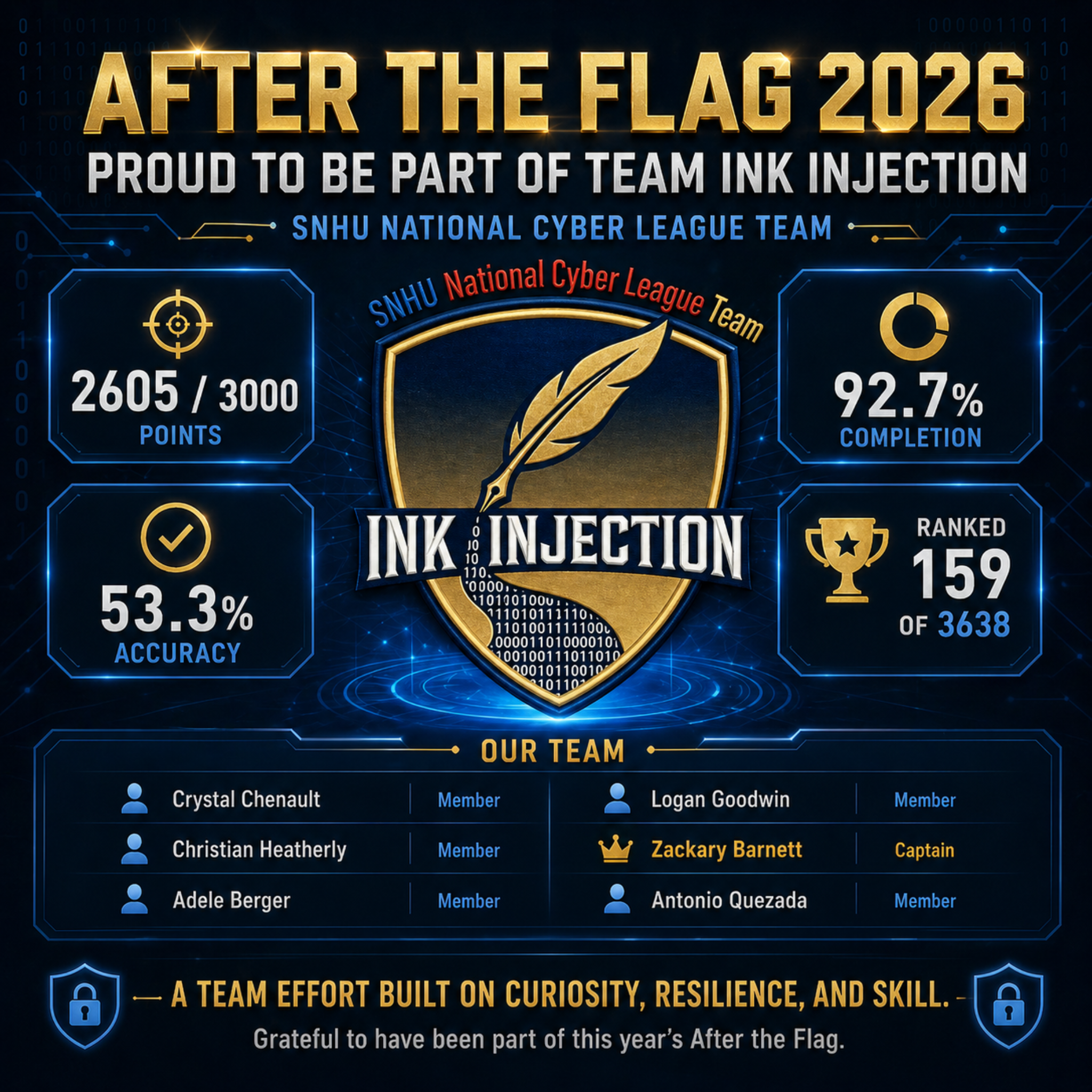
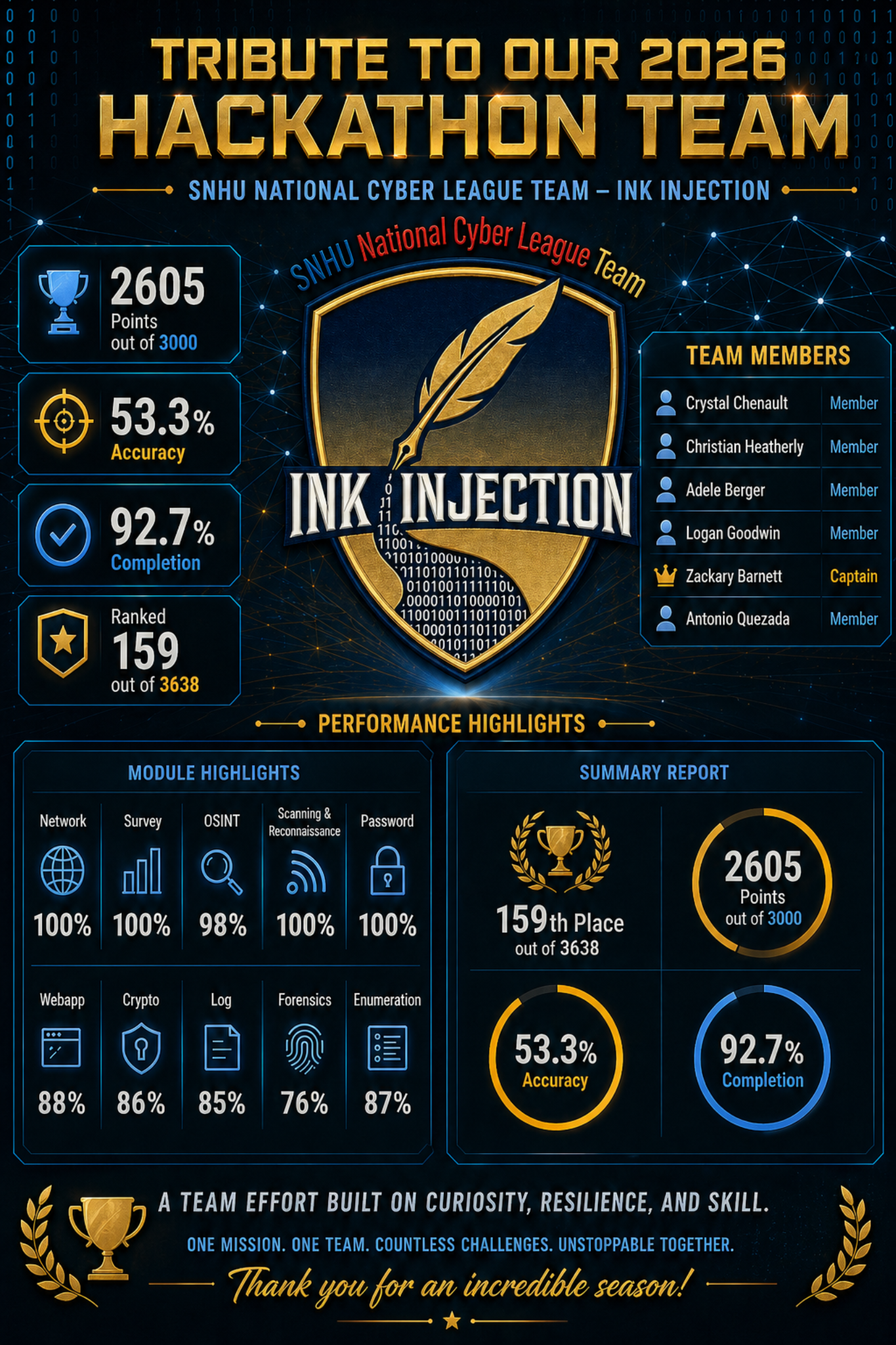
2605Points out of 3000
92.75%Completion
159Rank out of 3638
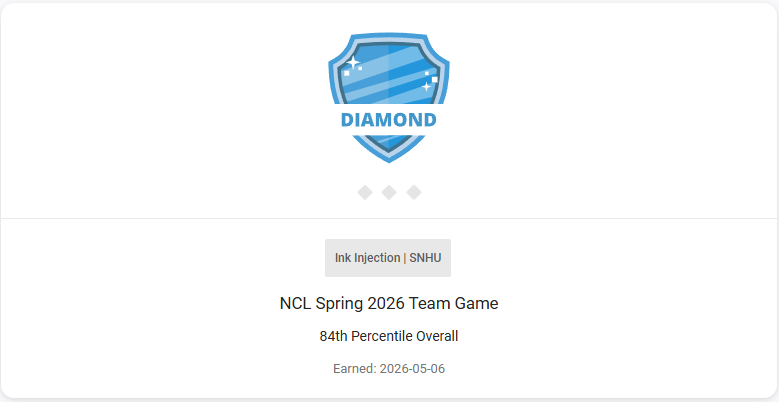
DiamondTeam Game badge
84thTeam percentile overall
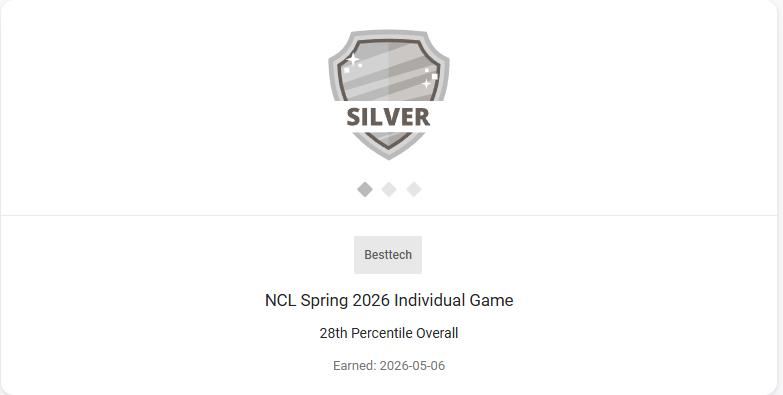
SilverIndividual Game badge
28thIndividual percentile overall
53.27%Accuracy
My role
I participated as a member of SNHU Team Ink Injection. I treated the competition like an applied security lab: read the prompt carefully, identify what evidence was available, choose the right tool or method, validate the answer, and document what the result meant from a defensive security perspective.
Why this belongs in my portfolio
The event demonstrates hands-on cybersecurity thinking under time pressure. It connects directly to the type of work I want to keep building on: network traffic analysis, incident response support, log review, credential security, vulnerability discovery, and structured troubleshooting.
This portfolio version focuses on skills, process, and verified team results. It intentionally avoids publishing live flags, answer strings, or anything that would weaken the integrity of CTF challenges.
| Module |
Correct |
Attempts |
Accuracy |
Completion |
Points |
| Open Source Intelligence | 44 | 77 | 57.1% | 97.8% | 370 / 385 |
| Cryptography | 12 | 15 | 80% | 85.7% | 250 / 360 |
| Password Cracking | 26 | 37 | 70.3% | 100% | 355 / 355 |
| Log Analysis | 17 | 29 | 58.6% | 85% | 225 / 300 |
| Network Traffic Analysis | 24 | 25 | 96% | 100% | 300 / 300 |
| Forensics | 13 | 50 | 26% | 76.5% | 235 / 300 |
| Scanning & Reconnaissance | 14 | 20 | 70% | 100% | 300 / 300 |
| Web Application Exploitation | 15 | 41 | 36.6% | 88.2% | 240 / 300 |
| Enumeration & Exploitation | 13 | 41 | 31.7% | 86.7% | 230 / 300 |
| Survey | 1 | 1 | 100% | 100% | 100 / 100 |
| Total | 179 | 336 | 53.27% | 92.75% | 2605 / 3000 |
Skills demonstrated
What the CTF tested.
Network traffic analysisReviewed protocol behavior and traffic evidence to validate suspicious or relevant activity.
Password crackingUsed hash identification logic, wordlist strategy, and credential-security thinking.
OSINT investigationConnected clues across public information sources while keeping evidence organized.
Scanning and reconnaissanceMapped services, interpreted findings, and prioritized what mattered in the challenge context.
Log analysisLooked for patterns, timestamps, anomalies, and useful indicators within event data.
Web and enumeration workApplied structured testing, input review, and exploitation awareness without guessing.
Reflection
Defensive takeaways.
- Evidence beats assumptions. The strongest answers came from verifying artifacts, logs, packets, hashes, or visible clues instead of relying on first impressions.
- Team performance depends on communication. In a broad CTF, the team has to divide categories, avoid duplicate effort, and share findings clearly.
- Completion matters, but accuracy matters too. The 92.75% completion rate shows broad coverage, while the accuracy score is a reminder that careful validation is part of security work.
- CTF practice translates to real operations. OSINT, log review, traffic analysis, scanning, and credential analysis are all useful in incident response, help desk escalation, and junior security roles.
Answer-ready project summary
What does this project demonstrate? NCL Spring 2026 Team Game & CTF Hash-Cracking demonstrates practical cybersecurity, IT infrastructure, documentation, and risk-aware problem solving through a concrete portfolio artifact.
Why does it matter? The project shows how technical work can be translated into clear evidence, recommendations, controls, and supportable decisions for real IT and cybersecurity environments.